Late Payment Reminder Email: Templates That Get You Paid
Late Payment Reminder Email: Templates That Get You Paid
Key takeaways
- Most late invoices are not refusals. They are stuck in a queue, sent to the wrong inbox, or waiting on an approval nobody asked for. A clear reminder fixes most of them.
- Send five messages on a fixed schedule: 3 days before the due date, on the due date, 7 days late, 14 days late, and a final notice at 30 days late.
- Every reminder should include the invoice number, amount, due date, a payment link, and one specific question the client can answer.
- Each step gets firmer but never personal. Move from "just checking" to a dated deadline and a stated consequence.
- Late fees only work if they were on the invoice and in the contract before the work started.
A late payment reminder email is a short, specific message that tells a client an invoice is due or overdue and makes paying it the easiest next step. The best ones read like a calendar notice, not a complaint. This guide gives you five templates you can copy, a schedule for sending them, and the math on what a late invoice actually costs you.
Why do clients pay late in the first place?
Clients usually pay late because of process, not intent. The invoice went to a project manager instead of accounts payable. It is missing a PO number. It landed a day after the client's monthly payment run. Someone needs to approve it and does not know that.
That matters for how you write. If you assume bad faith, your first reminder sounds like an accusation, and the person reading it is often an AP clerk who did nothing wrong. If you assume a process problem, your reminder asks the question that unsticks it: "Is there anything you need from me to process this?"
Speeding up collections is one of the basic cash flow levers the SBA points small businesses to, alongside negotiating longer terms with your own suppliers (SBA on net 30 accounts and cash flow). Clean invoices also prevent many of these problems before they start. Payment terms with a calendar due date, a PO reference, and payment instructions on the invoice itself remove most of the reasons an invoice stalls. We cover the setup side in our guide to getting paid faster with payment terms.
What should every payment reminder email include?
Every reminder should let the reader pay or reply in under a minute without opening another email. Include:
- Invoice number and amount in the subject line and the first sentence.
- The original due date as a calendar date, not "net 30."
- A payment link or payment instructions. Do not make them dig up the original invoice.
- The invoice attached again as a PDF.
- One specific question. "Can you confirm a payment date?" gets answered. "Let me know!" does not.
Keep the subject line plain and searchable. "Invoice 1042 from [Your Business]: $4,800 due Dec 2" will be found later. "Quick follow up" will not.
When should you send each payment reminder?
Use a fixed schedule so you are never deciding in the moment whether it is "too soon" to ask. For a net 30 invoice:
| Timing | Message | Tone |
|---|---|---|
| 3 days before due | Courtesy heads-up | Friendly, informational |
| Due date | Due today | Friendly, direct |
| 7 days late | First overdue notice | Polite, asks for a date |
| 14 days late | Second overdue notice | Firm, names the late fee or next step |
| 30 days late | Final notice | Formal, dated deadline and consequence |
Add a phone call or a short message to your main contact between day 7 and day 14. Email gets filtered. A 2-minute call often finds the real blocker, like a missing W-9 or an approver on vacation.
For longer terms, keep the same shape but add earlier check-ins. A net 60 invoice benefits from a "received and in process?" note around day 30, which we walk through in our net 60 payment terms guide.
Late payment reminder email templates
Copy these and swap in your details. Brackets mark what to change.
Template 1: Courtesy reminder (3 days before the due date)
Subject: Invoice [1042] for $[4,800] due [Dec 2]
Hi [Name],
A quick heads-up that invoice [1042] for $[4,800] is due on [Wednesday, December 2]. I've attached it again here, and you can pay online at [payment link].
If it needs to go to someone else in your AP team, let me know who and I'll send it directly.
Thanks, [Your name]
This one is not a reminder about being late. It catches routing problems while there is still time to fix them before the due date.
Template 2: Due today
Subject: Invoice [1042] for $[4,800] due today
Hi [Name],
Invoice [1042] for $[4,800] is due today. You can pay here: [payment link]. The invoice is attached for your records.
If it's already been sent, thank you, and feel free to ignore this.
[Your name]
Short on purpose. The "if it's already been sent" line keeps it friendly when a payment crosses in the mail.
Template 3: First overdue notice (7 days late)
Subject: Overdue: invoice [1042] for $[4,800], due [Dec 2]
Hi [Name],
I haven't received payment yet for invoice [1042] for $[4,800], which was due on [December 2]. I've attached it again, and the payment link is here: [payment link].
Could you confirm when this is scheduled to go out? If anything is holding it up, like a missing PO number or a form, tell me what you need and I'll send it today.
Thanks, [Your name]
This is the most important message in the sequence. It asks for a date in writing and offers to remove any blocker. Most late invoices get resolved here.
Template 4: Second overdue notice (14 days late)
Subject: Second notice: invoice [1042], 14 days past due
Hi [Name],
Following up on invoice [1042] for $[4,800], now 14 days past its [December 2] due date. I haven't heard back on a payment date.
Per our agreement, invoices more than 15 days past due accrue a late fee of [1.5% per month]. I'd rather not apply it, so please pay by [December 18] or reply with a date that works.
I've also copied [AP contact or finance email] in case this needs to go to them.
[Your name]
Name the consequence that is already in your contract, give a specific date, and widen the audience to someone who can actually release the payment. Do not invent a fee here that was not agreed up front.
Template 5: Final notice (30 days late)
Subject: Final notice: invoice [1042], payment due by [January 8]
Hi [Name],
Invoice [1042] for $[4,800] is now 30 days past due. I've sent reminders on [Dec 9] and [Dec 16] and haven't received payment or a payment date.
Please pay the balance of $[4,872], which includes the late fee in our agreement, by [January 8]. Until the account is current, I'm pausing work on [project]. If I haven't heard from you by then, I'll move to the next steps outlined in our contract.
If there's a problem with the invoice or the work, I want to know. Reply here or call me at [number].
[Your name]
The final notice lists your earlier attempts, states the total, sets a deadline, and names what happens next. It still leaves the door open, because a dispute about the work is a different problem from a slow AP queue, and you want to find out which one you have.
How much does a late invoice actually cost you?
More than it looks. Take a $4,800 invoice dated November 2, 2026, on net 30 terms, so it is due December 2. The client pays 30 days late.
If your contract includes a 1.5% monthly late fee, that month late is worth $72 to you ($4,800 x 1.5%). That is 18% a year in simple terms, which is why clients notice it.
Now look at your side. If that $4,800 was covering rent and you bridge the gap on a credit card at 24% APR, 30 days of interest costs about $94.68 ($4,800 x 24% x 30 / 365). At 45 days late it is about $142.03. In this example the late fee would not even fully cover your borrowing cost, which is the case for sending reminders on schedule instead of waiting to see what happens.
The bigger cost is the knock-on effect. A late invoice can push income past an estimated tax date, leave your tax set-aside short, or force you to delay a bill. If one late client can do that, you need a forecast that shows the low point before it arrives. Our 90-day cash flow forecast guide walks through building one.
Can you charge late fees on overdue invoices?
Generally yes, if the fee was agreed before the work started. Put the late fee in your contract and print it on every invoice, for example: "Invoices more than 15 days past due accrue 1.5% interest per month." A fee you announce for the first time in a reminder is much harder to collect and tends to start an argument instead of a payment.
Limits on interest and late fees vary by state, so keep the rate reasonable and check your state's rules if you are unsure. Many freelancers waive the fee once as goodwill when a client pays quickly after the second notice. That is a fine trade.
Federal government clients are different. Under the Prompt Payment Act, federal agencies that pay a contractor late owe interest at a rate set by the Treasury, and the law says that interest is paid whether or not the contractor asks for it. You still want to send reminders, but you do not need a contract clause to be owed interest from a federal agency.
What if the client still does not pay?
After the final notice, your options get more formal and more expensive in time. In rough order:
- Pause work. If you have not already, stop delivering until the account is current. This is often the step that moves the invoice to the top of the pile.
- Offer a payment plan. Two or three smaller payments on fixed dates beat zero payments. Get it in writing.
- Send a formal demand letter. A short letter restating the amount, the contract terms, and a final deadline. Some freelancers have an attorney send it, which changes the tone.
- Small claims court. Dollar limits and filing rules vary by state, so check your local court's website.
- A collections agency. Agencies typically keep a meaningful share of what they recover, so this is usually a last resort.
Decide your own threshold ahead of time. Chasing a $300 invoice through small claims rarely makes sense. Chasing a $4,800 invoice often does.
Do you owe tax on an invoice that never gets paid?
On the cash method, which most freelancers use, income counts when you actually receive it, not when you invoice it (IRS Publication 538). So an unpaid invoice is generally not income yet, and you do not owe tax on money you never received.
The flip side: you also cannot deduct it as a bad debt. The IRS notes in Topic 453 that a cash method taxpayer generally cannot take a bad debt deduction for unpaid fees and similar items, because they were never included in income. Accrual method businesses are treated differently. This is general education, not tax advice, so check your own situation with a tax professional.
The practical takeaway is to plan your tax set-aside around money that has landed, not money you have billed. Revenue on paper is not what you keep, which we break down in why freelance revenue is not your income.
How do you stop chasing payments every month?
Make the reminders automatic and make the invoices hard to stall:
- Put the five reminder dates on your calendar the day you send the invoice, or turn on scheduled reminders if your invoicing tool has them.
- Ask for a deposit on new clients, so your exposure on any one invoice is smaller.
- Invoice on delivery, not at the end of the month.
- Track expected deposit dates, not just invoice dates, so you see a late payment coming in your cash plan.
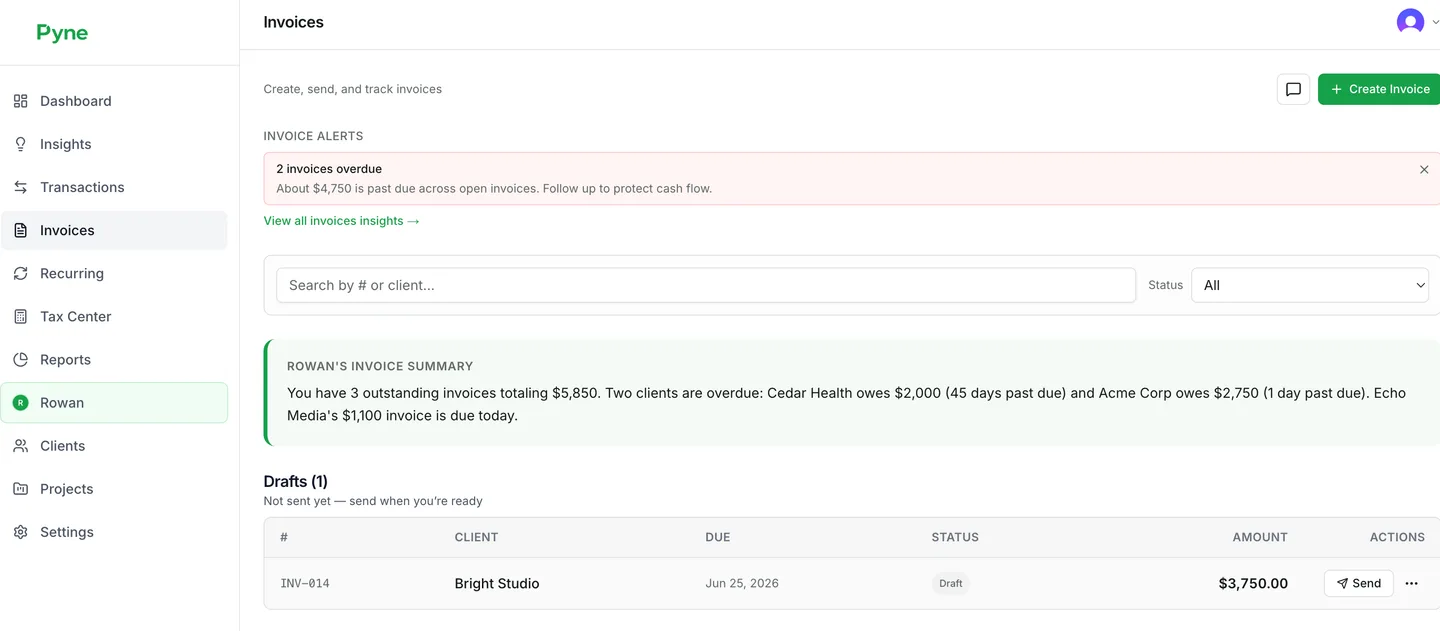
Pyne does the tracking side of this. It sends invoices with payment links, flags overdue invoices, lets you email a payment reminder in one click, and shows those invoices next to your cash forecast so you can see what a late client does to the next few weeks. Rowan, Pyne's AI financial copilot, can answer "if this invoice is two weeks late, can I still cover rent and my tax set-aside?" Pyne does not run the five-step schedule for you yet, so you still decide when each reminder goes out, and it will not make a client's AP team move faster. See Pyne pricing if you want reminders and forecasting in one place.
FAQ
How soon after the due date should I send a payment reminder?
Send a short "due today" note on the due date, then a first overdue reminder 7 days later. Waiting longer than a week makes the invoice easier to forget and tells the client you are not tracking it. A courtesy reminder 3 days before the due date also catches routing problems early.
How do I write a payment reminder that is polite but firm?
Stick to facts: invoice number, amount, due date, and a payment link. Ask one specific question, usually for a payment date. Each later message gets firmer by adding a deadline and naming the consequence already in your contract, like a late fee or a pause on work. Never make it personal.
Can I add a late fee if it was not in my contract?
You can ask, but it is much harder to collect and often damages the relationship. Late fees work best when they are in the contract and on every invoice before the work starts. For future clients, add the clause now. Limits on fees and interest vary by state.
Sources
Related
Pyne provides estimates and general financial insights for informational purposes only. This is not tax, legal, or financial advice.