How Self-Employment Tax Eats Your Freelance Income
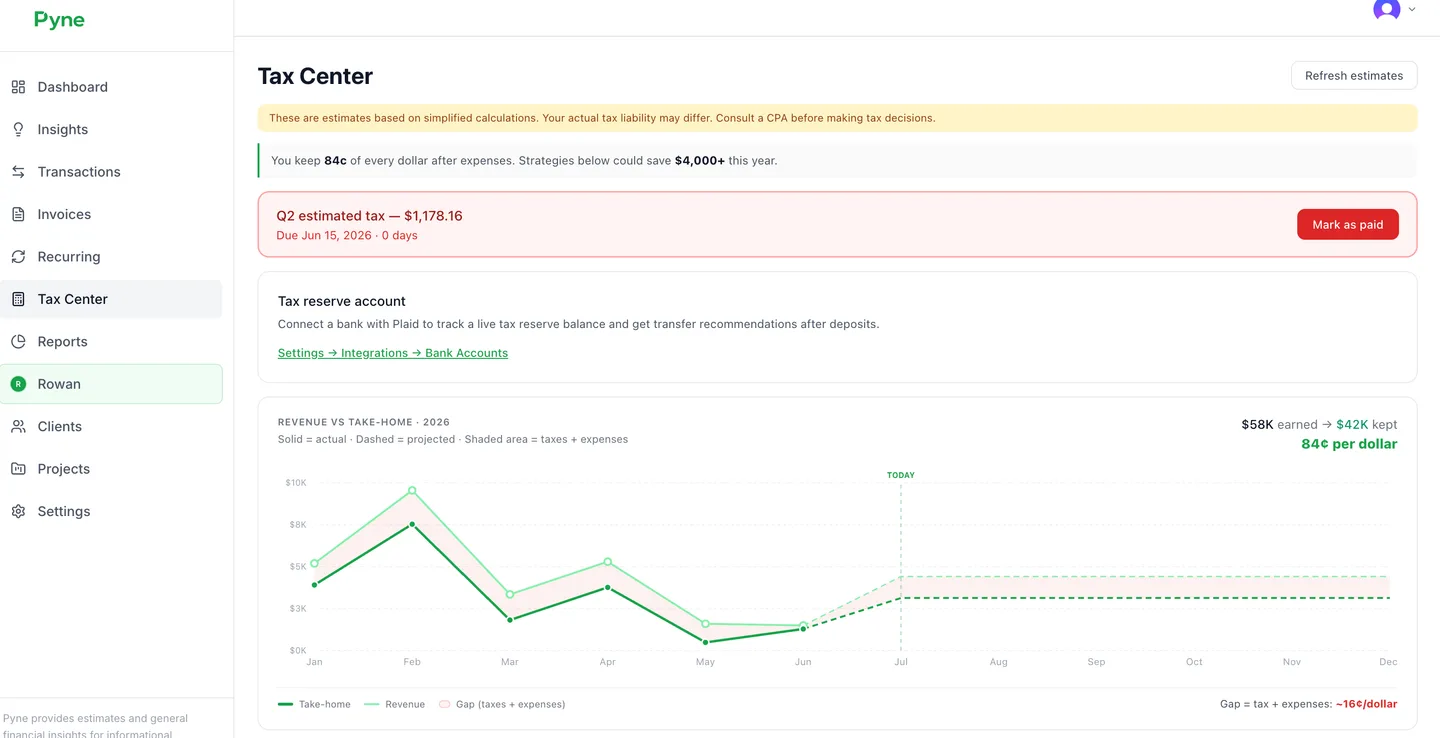
How Self-Employment Tax Eats Your Freelance Income
You made $100,000 freelancing last year. You think your tax bracket is 22%, so you set aside $22,000 and call it done. Then you file, and the bill is closer to $37,000. The gap is often self-employment tax.
Self-employment tax is the biggest "what you keep" surprise for many consultants and solo operators. It is not hidden. It just rarely gets explained clearly until after you owe it. This post is education, not tax advice. Confirm your numbers with a CPA.
What is self-employment tax, exactly?
Self-employment tax is Social Security and Medicare for people who work for themselves. When you hold a W-2 job, your employer pays half of those payroll taxes. You never see that half. It comes out before your paycheck, and your employer matches it.
When you freelance, you are both employer and employee. You pay both halves. That combined bill is self-employment tax.
The IRS self-employment tax rate is 15.3% of net self-employment income: 12.4% for Social Security and 2.9% for Medicare. The Social Security portion applies only up to the annual contribution and benefit base (SSA publishes that base each year). Medicare has no earnings cap. If combined wages and self-employment income exceed $200,000 as a single filer, an additional 0.9% Medicare tax can apply.
Self-employment tax is not income tax. It stacks on top of income tax. That is the part that stings.
How does the SE tax math actually work?
Example: say you net $80,000 after business expenses.
The IRS figures SE tax on 92.35% of net earnings (not the full net), which approximates the employer half. For this example, that is about $73,880 of SE-taxable earnings.
Your SE tax: $73,880 x 15.3% = roughly $11,304.
You can deduct the employer-equivalent half of SE tax when figuring adjusted gross income. That deduction only lowers income tax. It does not reduce the SE tax itself. On about $11,304 of SE tax, the deductible half is roughly $5,652, so AGI starts near $74,348 before other adjustments.
Federal income tax still applies on that adjusted income. Depending on filing status and deductions, another $8,000 to $12,000 is common in middle ranges. Add state income tax if your state has one, and many freelancers land near 30-35% of net freelance income in total tax, not the single bracket percentage they expected.
The SE tax alone, that roughly $11,304, is money a W-2 employee often never budgets for because the employer quietly pays half.
Why does SE tax change how you should price?
If you left a job paying $80,000 to freelance, you need to earn more than $80,000 to take home a similar amount. How much more depends on your full picture, but the employer half of Social Security and Medicare alone often means several thousand dollars of extra gross revenue just to stay even.
Freelancers who set rates from an old salary often feel poorer than the headline rate suggests. Take-home falls unless SE tax, income tax, and operating costs are priced into the rate.
When you set a freelance rate, ask what you need to charge so that after SE tax, income tax, and business expenses you keep what you need. "What did my old job pay per hour" is the wrong starting point.
How should you plan for the bill?
A simple approach is to set aside 25-30% of every client payment in a separate tax account. That buffer often covers SE tax plus federal income tax for middle-income solo operators. If your state has income tax, many people bump the set-aside toward 30-35%.
A more precise approach is to project annual SE tax and income tax, then divide by four for quarterly estimated payments. The IRS estimated tax rules explain who must pay and when. Underpaying by a deadline can trigger penalties even if you are due a refund later.
Either way, plan against the real combined obligation, not the income-tax bracket alone. Tools that track invoices and tax set-asides help; see Pyne pricing if you want that in one place. Rowan, Pyne's AI financial copilot, is built to help you see what you keep, not to replace a CPA.
Does the employer-half deduction fix the gap?
The deduction for half of your SE tax is above the line. You get it whether or not you itemize. It reduces AGI and therefore income tax.
It does not erase the cost of paying both Social Security and Medicare halves. After income-tax savings, the effective hit is a bit less than a raw 15.3%, but it is still large.
Example: on the $80,000 case above, the half-SE deduction might save roughly $1,200 to $1,500 of income tax depending on your bracket. Real money. Not enough to close the gap between "my bracket is 22%" and the final bill.
Self-employment tax is the cost of being your own employer. It is predictable and calculable. Freelancers who handle it well price it into rates early and move money to taxes before treating deposits as spendable income.
If a prior tax bill surprised you, SE tax was likely part of the reason. Once you know the structure, you can plan for it. Talk with a CPA about your specific situation, especially if you are weighing an S corporation election at higher income levels.
Sources
See what's coming with your money →
Related
Pyne provides estimates and general financial insights for informational purposes only. This is not tax, legal, or financial advice.