How Much to Set Aside for Taxes as a Freelancer in 2026
How Much to Set Aside for Taxes as a Freelancer in 2026
Key takeaways
- Most solo freelancers with no other income should set aside roughly 20% to 26% of net profit for federal tax in 2026, then add their state rate on top.
- Self-employment tax is a flat 15.3% on 92.35% of net earnings, so it is the biggest piece for most freelancers under about $100,000 in profit.
- Set aside from every deposit, not at the end of the quarter. A fixed percentage moved into a separate account the day money lands is the system that holds up.
- Your marginal set-aside is higher than your average. Once you are past your first $50,000 or so of profit, each extra $1,000 can carry $230 to $305 in federal tax alone.
- The fourth 2026 estimated payment is due January 15, 2027. Paying 100% of last year's tax (110% if your 2025 AGI was over $150,000) protects you from the underpayment penalty.
You got paid $6,500 this morning. The question is not whether some of it belongs to the IRS. It is how much, and the honest answer depends on your profit, not your revenue. This guide walks through the 2026 numbers, shows a full worked example, and gives you a percentage you can actually use on every deposit. It is education, not tax advice. Check your own situation with a tax professional.
How much should a freelancer set aside for taxes?
For a single freelancer whose only income is self-employment, a federal set-aside of 20% to 26% of net profit covers most people between $50,000 and $150,000 in profit in 2026. Add your state income tax rate on top. If you live in a state with no income tax, the federal number is your whole set-aside.
That range comes from running the actual 2026 IRS math, shown below. It is lower than the old "set aside 30%" advice for many people because of two deductions most rules of thumb ignore: the deduction for half of your self-employment tax and the qualified business income deduction. It is higher than many new freelancers expect because self-employment tax applies from the first dollar of profit, with no standard deduction to soften it.
Note the word profit. Revenue minus business expenses is what gets taxed. If you bill $100,000 and spend $15,000 on software, contractors, and equipment, your tax math starts at $85,000. We cover why that gap matters in why your freelance revenue is not your income.
What taxes does a freelancer actually owe?
Three layers stack on top of each other.
Self-employment tax. This is Social Security and Medicare for people who work for themselves. The IRS sets the rate at 15.3%: 12.4% for Social Security and 2.9% for Medicare. It applies to 92.35% of your net earnings, and you owe it once your net earnings from self-employment reach $400. For 2026, the Social Security part stops at $184,500 of combined wages and self-employment earnings, a figure the Social Security Administration publishes each year. Medicare has no cap. We break this layer down in detail in how self-employment tax eats your freelance income.
Federal income tax. Your profit, minus half of your self-employment tax, minus the standard deduction, minus the qualified business income deduction, is taxed at the regular brackets. For 2026, the standard deduction is $16,100 for single filers and $32,200 for married couples filing jointly, per the 2026 Form 1040-ES.
State income tax. This varies widely, from zero in some states to high single digits or more in others. Look up your own state's rate rather than using a national average.
The two deductions that lower your set-aside
First, you can deduct the employer-equivalent half of your self-employment tax when figuring adjusted gross income. That lowers income tax, not self-employment tax.
Second, the qualified business income deduction lets many sole proprietors deduct up to 20% of their qualified business income, limited to 20% of taxable income. The 2026 Form 1040-ES notes that recent legislation made this deduction permanent. Above certain income limits it can shrink, especially for consulting and other service businesses, so check the Form 8995 instructions if your income is high.
What are the 2026 federal tax brackets for a single freelancer?
These are the 2026 rates for single filers from IRS Publication 505, applied to taxable income after deductions:
| Taxable income | Rate on that slice |
|---|---|
| $0 to $12,400 | 10% |
| $12,400 to $50,400 | 12% |
| $50,400 to $105,700 | 22% |
| $105,700 to $201,775 | 24% |
| $201,775 to $256,225 | 32% |
| $256,225 to $640,600 | 35% |
| Over $640,600 | 37% |
For married couples filing jointly, the 10% bracket runs to $24,800, 12% to $100,800, and 22% to $211,400. Your bracket is not your set-aside percentage. Only the top slice of income is taxed at your top rate, and self-employment tax sits on top of all of it.
Worked example: $100,000 in revenue, $85,000 in profit
Say you are a single freelance designer in 2026. You bill $100,000, spend $15,000 on business expenses, and have no other income. Here is the federal math, step by step.
| Step | Calculation | Amount |
|---|---|---|
| Net profit | $100,000 minus $15,000 | $85,000.00 |
| Earnings subject to SE tax | $85,000 x 92.35% | $78,497.50 |
| Self-employment tax | $78,497.50 x 15.3% | $12,010.12 |
| Deductible half of SE tax | $12,010.12 / 2 | $6,005.06 |
| Adjusted gross income | $85,000 minus $6,005.06 | $78,994.94 |
| Minus standard deduction | $78,994.94 minus $16,100 | $62,894.94 |
| QBI deduction | Lesser of 20% x $78,994.94 or 20% x $62,894.94 | $12,578.99 |
| Taxable income | $62,894.94 minus $12,578.99 | $50,315.95 |
| Federal income tax | $1,240 + 12% x ($50,315.95 minus $12,400) | $5,789.91 |
| Total federal tax | $12,010.12 + $5,789.91 | $17,800.03 |
That is 20.9% of profit, or 17.8% of revenue. Notice that self-employment tax is more than twice the income tax here. For many freelancers in this range, that is the bill that surprises them.
Now add a state. If your state took a flat 5% of the $85,000 (state rules differ, so treat this as an illustration), that is another $4,250. Total: $22,050.03, or 25.9% of profit and 22.1% of revenue.
So for this designer, setting aside 22% of every client payment covers federal and state. The $6,500 deposit from this morning means moving $1,430 to the tax account today. Split across four estimated payments, the federal share is about $4,450 per quarter.
What percentage should you set aside at different income levels?
We ran the same 2026 math across a range of profit levels. Assumptions: single filer, no other income, standard deduction, simple QBI deduction, no retirement contributions or health insurance deduction. Federal only, so add your state rate.
| Net profit | Total federal tax | Share of profit | Federal tax on the next $1,000 |
|---|---|---|---|
| $30,000 | $5,181 | 17.3% | $216 |
| $50,000 | $9,732 | 19.5% | $231 |
| $75,000 | $15,495 | 20.7% | $231 |
| $100,000 | $22,365 | 22.4% | $305 |
| $125,000 | $29,986 | 24.0% | $305 |
| $150,000 | $37,608 | 25.1% | $305 |
Two things to take from this table.
First, the average rate climbs slowly. Going from $50,000 to $150,000 in profit only moves the average from about 20% to about 25%.
Second, the marginal rate is what matters for a good month. Once your taxable income crosses into the 22% bracket, each extra $1,000 of profit carries roughly $305 in federal tax. If you are having a record year, a flat 20% set-aside will fall short on the last few invoices. Raise your percentage when you know a big month is coming instead of finding out in April.
If you are married filing jointly, have a W-2 job on the side, or have a spouse with wages, your numbers will differ. Wages can use up the Social Security cap and change your bracket. Run your own figures with the worksheet in the Form 1040-ES or ask a tax professional.
How do you set aside taxes from each payment?
The system matters more than the exact percentage. A slightly wrong number applied every time beats a perfect number applied when you remember.
- Pick one percentage. Use the table above for federal, add your state rate, and round up to the nearest whole number. Our example designer uses 22%.
- Open a separate savings account just for taxes. Name it "Taxes" so it never looks like spending money. An FDIC-insured high-yield savings account works well, and FDIC deposit insurance covers up to $250,000 per depositor, per insured bank, for each ownership category.
- Move the money the day each deposit lands. Not at the end of the month. Every client payment triggers a transfer of your percentage.
- Pay estimated taxes from that account only. Four times a year, the payment comes out of the tax account, never your checking.
- Check the balance against your actual profit each quarter. If expenses were lower than you planned or a big contract came in, true it up.
Keeping the tax money out of sight is what makes this work. A $40,000 checking balance feels like $40,000 until you remember $9,000 of it is spoken for. The day-of transfer also smooths out lumpy income, which pairs well with a 90-day cash flow forecast.
When are 2026 estimated tax payments due?
The IRS generally expects you to pay estimated taxes if you expect to owe $1,000 or more when you file, per the IRS estimated taxes page. The 2026 Form 1040-ES lists these due dates:
| Payment | Due date |
|---|---|
| 1st | April 15, 2026 |
| 2nd | June 15, 2026 |
| 3rd | September 15, 2026 |
| 4th | January 15, 2027 |
The first three have passed. The one left for tax year 2026 is January 15, 2027. You can skip it if you file your 2026 return by February 1, 2027 and pay the full balance with it.
How safe harbor changes the math
You avoid the underpayment penalty if your payments cover the smaller of 90% of your 2026 tax or 100% of your 2025 tax. If your 2025 adjusted gross income was over $150,000 ($75,000 if married filing separately), the prior-year number becomes 110%.
This gives you a useful split. Your estimated payments can be based on last year's tax, which is a known number. Your set-aside account should be based on this year's income, which is the real bill. If you had a much bigger year than last year, safe harbor protects you from the penalty but not from the balance due in April. The set-aside covers that.
What are the most common set-aside mistakes?
- Using your bracket as your set-aside. "I'm in the 12% bracket" ignores self-employment tax, which is often the larger bill.
- Setting aside from revenue but forgetting it is revenue. If your expenses are high, a percentage of revenue can overshoot. If they are low, it is closer to a percentage of profit. Know which one you are using.
- Not adjusting after a big month. Your marginal rate is higher than your average rate. A record quarter needs a bigger transfer.
- Dipping into the tax account. If you borrow from it, write down the amount and pay it back first, before any discretionary spending.
- Forgetting state estimates. Many states with an income tax have their own estimated payment schedule.
How Pyne handles the set-aside
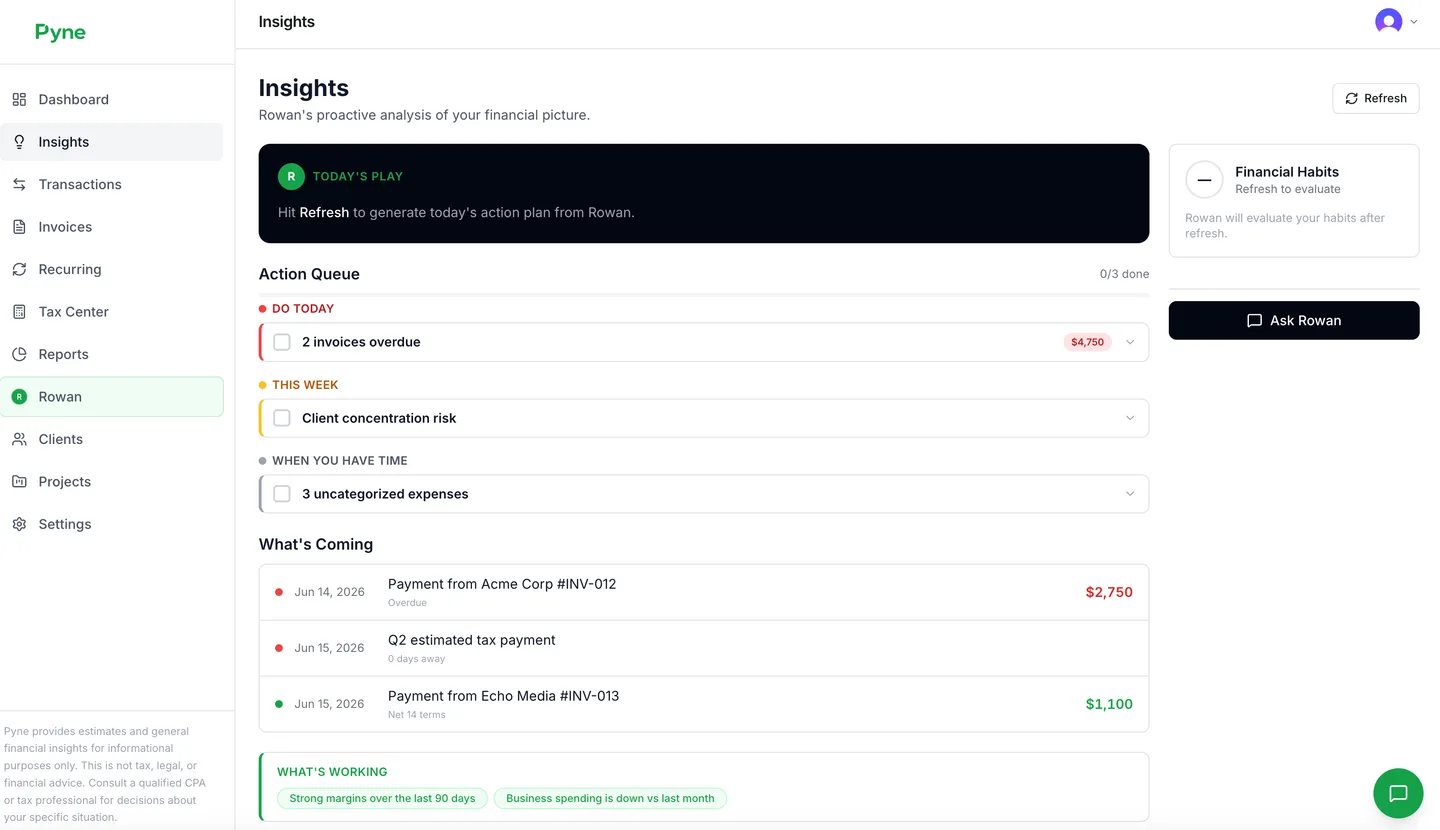
Pyne tracks client deposits as they land and suggests a tax set-aside for each one, then compares a designated tax reserve account against what your quarterly estimate says you need. Rowan, Pyne's AI financial copilot, can answer "how much of this payment is actually mine?" from your real numbers. Pyne does not file or pay your taxes, and it does not replace a CPA on complex situations like S corp elections or multi-state income. It is built to make the day-of transfer a habit instead of a chore. See Pyne pricing to compare plans.
FAQ
Is 30% too much to set aside for taxes as a freelancer?
For many single freelancers under $100,000 in profit in a low-tax state, 30% is more than federal and state tax will actually take. That is not a bad problem: the extra becomes savings in April. If you live in a high-tax state or have a large income, 30% may be close to right. Run the worksheet with your own numbers.
Should I set aside a percentage of revenue or profit?
Profit is what gets taxed, so profit is more accurate. Revenue is easier, because you know it the moment a payment lands. A practical compromise: set aside a percentage of each deposit that you calibrated against your expected profit, like the 22% of revenue in the worked example.
Do I need to set aside for self-employment tax if I have a W-2 job too?
Yes, if your net self-employment earnings are $400 or more. Your W-2 wages count toward the $184,500 Social Security cap for 2026, so high wages can reduce the Social Security part of your self-employment tax. You can also increase your W-2 withholding to cover freelance tax instead of making separate estimated payments.
What if I under-set-aside this year?
Start setting aside the right percentage now, and make the January 15, 2027 estimated payment as large as you can. If you met safe harbor through your earlier payments, you avoid the penalty even if you owe more in April. If you will owe more than you can pay, the IRS has payment plan options, and it is better to file on time either way.
Does the QBI deduction apply to every freelancer?
Many sole proprietors qualify, but there are limits. The deduction is capped at 20% of taxable income, and at higher incomes it can phase down, especially for service businesses like consulting. Income you earn as an employee does not count. Check the Form 8995 instructions or ask a tax professional if you are near the limits.
Sources
- IRS: Self-employment tax (Social Security and Medicare taxes)
- IRS Publication 505 (2026): Tax Withholding and Estimated Tax
- IRS Form 1040-ES (2026): Estimated Tax for Individuals
- IRS: Estimated taxes
- IRS: Qualified business income deduction
- IRS: Instructions for Form 8995
- Social Security Administration: Contribution and Benefit Base
- FDIC: Understanding Deposit Insurance
Related
Pyne provides estimates and general financial insights for informational purposes only. This is not tax, legal, or financial advice.