Business Bank Account for Freelancers: When and How to Open One
Business Bank Account for Freelancers: When and How to Open One
Key takeaways
- Open a separate business checking account as soon as you take your first paid client. The IRS tells new businesses to do it first, and it is the cheapest bookkeeping fix you will ever make.
- A sole proprietor is not legally required to have one in most cases, but mixing funds makes your records, your tax set-aside, and your cash flow harder to read.
- Most banks will open a sole proprietor account with your Social Security number. An EIN is free from the IRS if your bank asks for one or you want to stop handing out your SSN.
- A sole proprietor account at the same bank as your personal accounts shares one $250,000 FDIC limit with your single accounts. LLC and corporation accounts are insured separately.
- The setup that works: one business checking account where every client payment lands, one tax reserve savings account, and one fixed transfer to your personal account.
A client pays, the money lands in personal checking, and coffee, software, and rent all come out of the same account. It works until tax season, when you are scrolling through 12 months of statements guessing which charges were for work. A separate business bank account fixes that, and it takes less than an hour to set up. This guide covers when you need one, what the bank will ask for, how deposit insurance works, and how to wire it into a system that runs on its own.
Do freelancers need a separate business bank account?
If you are a sole proprietor or a single-member LLC, you are usually not legally required to open one. You should anyway. IRS Publication 583, the agency's guide to starting a business, says it directly: "One of the first things you should do when you start a business is open a business checking account." It adds that "you should keep your business account separate from your personal checking account" and that you should "use the business account for business purposes only."
The reason is records. The IRS says everyone in business must keep records, and that good records help you "separate business from nonbusiness receipts and taxable from nontaxable income." When every client payment and every business expense runs through one account, your bank statement does most of that work for you. When they are mixed in with groceries, transfers from a partner, and a refund from an online store, you have to reconstruct the split by hand.
If you formed an LLC or corporation, treat a separate account as required. Business and personal funds sitting in one account blur the line between you and the company, which is the line the entity exists to draw. How courts treat that varies by state, so talk to an attorney if you are relying on an entity for liability protection. This guide is general education, not legal or tax advice.
What goes wrong when you mix business and personal money?
Three things, and all of them get worse as your income grows.
Your tax records get thin. Publication 583 lists the documents that support your return: "sales slips, paid bills, invoices, receipts, deposit slips, and canceled checks," and notes that if you lack a canceled check, "you may be able to prove payment with certain financial account statements prepared by financial institutions." A clean business account statement is that proof. A mixed personal statement is a pile of transactions you have to explain one at a time.
You miss deductions. The IRS warns that "you may forget expenses when you prepare your tax return unless you record them when they occur." A $29 monthly tool buried between personal card charges is easy to miss. Miss it for a year and that is $348 of expenses you never deducted.
You cannot see your business. Revenue and income are different numbers, and a mixed account hides both. If your checking balance is $11,000, how much of that belongs to the IRS, how much is next month's software and contractor bills, and how much is actually yours? We break that gap down in why your freelance revenue is not your income. With a business account, the balance at least answers one question cleanly: what does the business have right now.
There is also the audit question. Publication 583 says you "must keep your business records available at all times for inspection by the IRS," and the general period of limitations for assessing more tax is 3 years. It stretches to 6 years if you leave out income that is more than 25% of the gross income shown on your return. Clean, separate statements make that window much less stressful.
When should you open a business bank account?
Open it before your first client payment, or the week you realize you have not. There is no income threshold that triggers it. Common moments people finally do it:
- You landed your first paying client or signed your first contract.
- You are sending invoices and want clients to pay a business name, not your personal name.
- You want to accept card payments. The SBA notes that business banking means "customers will be able to pay you with credit cards and make checks out to your business instead of directly to you."
- You formed an LLC or corporation. Open the account right after the entity and EIN exist.
- You are about to make your first estimated tax payment and realize you cannot tell how much profit you have.
If you have been freelancing out of personal checking for a while, start the new account on the first of a month or quarter so the cutover is clean.
What do you need to open a business bank account?
Requirements vary by bank, but the SBA lists the most common documents:
- An Employer Identification Number (EIN), or a Social Security number if you are a sole proprietor
- Your business formation documents (for an LLC or corporation)
- Ownership agreements (if there is more than one owner)
- A business license, if your city or state requires one
Many banks also ask for a DBA ("doing business as") filing if your business name is different from your legal name. The SBA notes that a DBA plus an EIN lets you open a business bank account, but a DBA by itself does not give you legal protection.
Do you need an EIN as a sole proprietor?
Often not. The IRS says you generally need an EIN to hire employees, operate a partnership or corporation, pay sales and excise taxes, or change your business structure. A sole proprietor with no employees can usually use their Social Security number. Many freelancers get an EIN anyway so they can put it on W-9 forms instead of their SSN. It is free and takes minutes online. The IRS says plainly: "You never have to pay a fee for an EIN." Any website charging you for one is a middleman.
How does FDIC insurance work for a freelancer's business account?
The FDIC's standard coverage is $250,000 per depositor, per insured bank, for each account ownership category. How your business account fits into that depends on how your business is set up.
Sole proprietor (including a DBA account). The FDIC says accounts in the name of a sole proprietorship are insured as the owner's single accounts. They are added to your personal single accounts at the same bank, and the total is insured up to $250,000. They do not get their own separate limit.
LLC or corporation. Deposits owned by an LLC or corporation are insured separately from the owners' personal deposits, with their own $250,000 limit at that bank.
Worked example: when a sole proprietor account goes over the limit
Say you have $230,000 in a personal savings account in your name alone, and you open a $35,000 sole proprietor business checking account at the same bank.
| Account | Ownership category | Balance |
|---|---|---|
| Personal savings | Single | $230,000 |
| Business checking (sole prop) | Single (combined) | $35,000 |
| Total in single category | $265,000 | |
| Insured | $250,000 | |
| Uninsured | $15,000 |
Most freelancers are nowhere near that limit. If you are, opening the business account at a different bank gives each its own $250,000.
How should you set up your business accounts?
You need three accounts, not ten. This is the same structure we use in our guide to paying yourself a salary from irregular income.
- Business checking. Every client payment lands here, and every business expense goes out of it. Publication 583 says to "deposit all daily receipts in your business checking account." This is also where your cash buffer lives.
- Tax reserve savings. A fixed percentage of every deposit moves here the day it lands. It only leaves to pay estimated taxes. Our guide on how much to set aside for taxes as a freelancer walks through picking the percentage.
- Personal checking. One transfer from business checking on a set schedule. Publication 583 puts it this way: write checks to yourself "only when making withdrawals from your business for personal use."
Add a business credit card if you want one. The SBA notes that business credit cards can help with large startup purchases and help establish a credit history for your business. Pay it from business checking only.
Worked example: one month through the system
Say a client pays you $6,800 in March. You set aside 25% for taxes, and your business expenses run $650 a month.
| Step | Account | Amount | Business checking after |
|---|---|---|---|
| Client payment lands | Business checking | +$6,800 | $6,800 |
| Same day: 25% tax transfer | Tax reserve | +$1,700 | $5,100 |
| Software, tools, contractor | Business checking | -$650 | $4,450 |
That $4,450 is what you can pay yourself from or leave as buffer. Without the separate accounts, you would be looking at your full personal checking balance and guessing. With them, the number is sitting in a single account with nothing else mixed in.
What should you look for in a business checking account?
Keep it simple. A freelancer's account does not need the features a retailer or a 40-person company needs. Check these:
- Monthly fee and how to waive it. Many accounts charge a fee unless you keep a minimum balance. Make sure the minimum is a number you will actually hold.
- Free incoming ACH and wires. Clients pay by ACH more than anything else. Fees on incoming payments eat into every invoice.
- A linked savings account. You want your tax reserve one click away, ideally at the same bank so transfers are instant.
- Bank feed or export. Your bookkeeping and forecasting tools should be able to read transactions automatically.
- FDIC insurance. Confirm the bank, or the partner bank behind an app, is FDIC insured.
How do you switch over from a mixed personal account?
Do it in one sitting:
- Open the business checking and tax reserve accounts. Same bank, linked.
- Update your payment details. Change the bank info on your invoices, invoicing tool, and payment processor payouts.
- Move subscriptions. Switch every business tool, domain, and software charge to the new account or a business card.
- Tell repeat clients. Send updated payment details and ask them to confirm the change before the next invoice.
- Pick a cutover date. Everything from that date forward is separate. Sort the old transactions once for this year's return and stop.
- Start the transfers. Tax reserve on every deposit, your pay on a fixed day. A 90-day cash flow forecast helps you pick a pay amount the account can sustain.
For the first month, a client or two will still pay the old account. Move that money to business checking the same day and note it, so the business account still holds every dollar the business earned.
How does Pyne fit in?
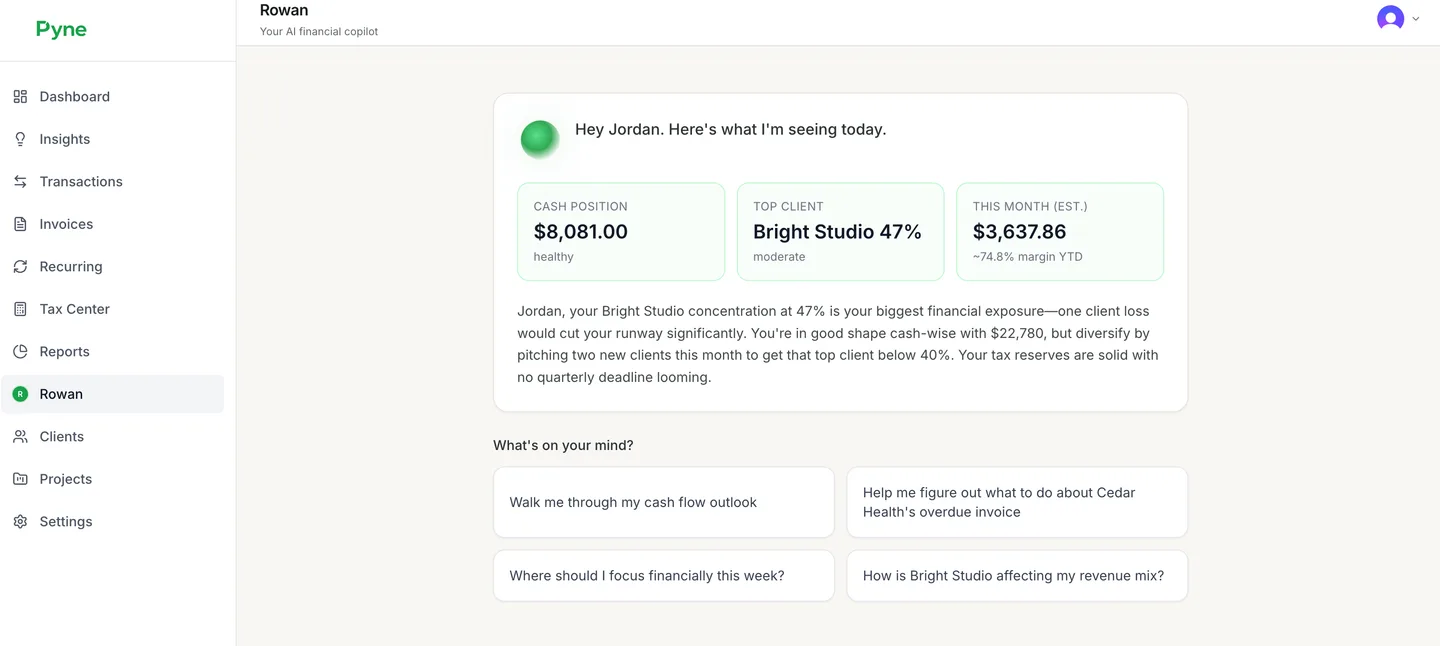
Pyne connects to your business and personal accounts and keeps them separate in one view. It tracks client deposits as they land, estimates your quarterly taxes from actual profit, and builds a rolling 90-day cash flow forecast from your real transactions and open invoices. Rowan, Pyne's AI financial copilot, can answer questions like "how much of my business checking balance is actually mine?" from your numbers. Pyne does not open accounts or move money for you, so the bank setup and the transfers are still yours. See Pyne pricing to compare plans.
FAQ
Is a business bank account required for a sole proprietor?
Usually not by law, but the IRS recommends it as one of the first steps when you start a business. Keeping business money in its own account makes your records cleaner, makes deductions easier to prove, and shows you what the business actually has. If you operate as an LLC or corporation, treat a separate account as required.
Can I use a second personal checking account for my business?
It is better than mixing everything into one account, and many freelancers start this way. The limits: clients may not be able to pay a business name, your bank's personal account terms may not allow business use, and you may not get merchant services or business credit. A real business account avoids those problems.
Do I need an EIN to open a business bank account?
Not always. The SBA lists an EIN, or a Social Security number if you are a sole proprietor, as what banks commonly ask for. LLCs and corporations generally need an EIN. Getting one from the IRS is free and takes minutes online, and it lets you keep your SSN off client W-9 forms.
How long should I keep business bank statements?
At least as long as the IRS can still review your return. Publication 583 lists a general period of 3 years, 6 years if you underreport income by more than 25% of the gross income on your return, and 7 years for bad debt or worthless securities claims. Many freelancers simply keep 7 years of statements.
Is my business account insured if the bank fails?
If the bank is FDIC insured, yes, up to the limit. A sole proprietor account is combined with your personal single accounts at the same bank for a total of $250,000. An LLC or corporation account gets its own separate $250,000 at that bank.
Sources
Pyne provides estimates and general financial insights for informational purposes only. This is not tax, legal, or financial advice.