How to Pay Yourself a Salary From Irregular Freelance Income
How to Pay Yourself a Salary From Irregular Freelance Income
Key takeaways
- Pay yourself a fixed amount on a fixed day, no matter what landed that month. Your business account absorbs the swings so your personal account does not.
- Base the salary on your last 12 months of profit after taxes, then take about 85% of the monthly average. The other 15% builds your buffer.
- Start with a buffer of two months of salary in the business account. Cap it at three months and pay anything above the cap to yourself as a quarterly bonus.
- If the buffer drops below one month of salary, cut the paycheck before the account runs dry, not after.
- As a sole proprietor, your tax is based on business profit, not on what you transfer to yourself. Set taxes aside before you calculate pay.
One month a client pays $11,500. Two months later, $2,600 comes in. If your personal spending follows your deposits, you end up feeling rich in May and broke in August, even when the year as a whole is fine. The fix is to stop paying yourself whatever arrived and start paying yourself a salary. This guide shows how to pick the number, how big the buffer needs to be, and what to do in a slow month, using a full 12-month example.
Why pay yourself a salary at all?
A salary separates two questions that irregular income tangles together: "How did the business do this month?" and "How much can I spend this month?" When those are the same question, every slow month turns into a personal budget crisis and every big month invites spending you cannot repeat.
A fixed paycheck also makes your personal finances look like everyone else's. Rent, a car payment, and groceries are monthly. Lenders ask for steady income. A savings plan only works if the deposit is predictable. The swings do not go away; they move into the business account, where a cash buffer is designed to handle them.
It also forces you to look at revenue and income as different numbers. A client deposit is not take-home pay. Fees, operating costs, and taxes come out first, which we break down in why your freelance revenue is not your income.
How does paying yourself work as a sole proprietor?
If you are a sole proprietor or single-member LLC taxed as one, you do not run payroll for yourself. You move money from the business account to your personal account. That transfer is often called an owner's draw. Its size does not change your tax bill.
Your federal tax is figured on the business's net profit for the year, whether you leave it in the business account or spend it. The SBA notes that sole proprietors report their personal and business income on the same form. Self-employment tax works the same way. The IRS says you usually must pay it if you had net earnings from self-employment of $400 or more, and the rate is 15.3%: 12.4% for Social Security and 2.9% for Medicare. For 2026, the Social Security portion applies to the first $184,500 of combined wages and self-employment earnings.
That has one practical consequence for your salary: set aside taxes before you decide what to pay yourself. If you pay yourself from pre-tax profit, the tax bill shows up in April with no money behind it. Our guide on how much to set aside for taxes as a freelancer walks through picking your set-aside rate.
If your business is a corporation, including an S corporation, the rules are different. The IRS says an officer of a corporation is generally an employee, and that wages paid to you as an officer should generally be commensurate with your duties. That means real payroll and a reasonable salary, which is a conversation to have with a CPA. The rest of this guide assumes a sole proprietor. It is education, not tax advice.
What accounts do you need?
Three accounts keep the system simple:
- Business checking. Every client payment lands here. Business expenses come out of it. This is where your buffer lives.
- Tax reserve. A separate savings account. A fixed percentage of every deposit goes here the day it arrives, and it only leaves to pay estimated taxes.
- Personal checking. Your paycheck lands here on the same day or days each month. Your personal bills come out of it.
The tax reserve is the account people skip, and it is the one that matters most. Money sitting in business checking looks spendable. Money in a separate account labeled for the IRS does not. If your reserve and buffer grow large, keep in mind that FDIC deposit insurance covers $250,000 per depositor, per FDIC-insured bank, for each account ownership category.
How do you calculate your freelance salary?
Use your own history, not a guess. Here is the method:
- Total your client deposits for the last 12 months. If you have less history, use what you have and be more conservative.
- Subtract business expenses. Software, equipment, contractors, insurance, and fees. What is left is profit.
- Subtract your tax set-aside. Apply your set-aside rate to profit. What is left is after-tax profit, the money that is actually available to you.
- Divide by 12 for a monthly average.
- Take about 85% of that average as your salary. Round down. The remaining 15% or so funds the buffer and future bonuses.
Why 85% and not 100%? Because the average assumes the next 12 months look like the last 12. If you pay out the full average, any slow stretch drains the buffer with nothing to refill it. Paying slightly under the average means the buffer grows in a normal year and survives a weak one.
If your income has been trending down, or you just lost a large client, use 70% to 80% instead, or base the salary on your slowest six months rather than the full year.
Worked example: a designer with lumpy income
Here is a freelance designer's last 12 months of client deposits:
| Month | Deposits | After expenses and tax |
|---|---|---|
| 1 | $4,200 | $2,625 |
| 2 | $9,800 | $6,825 |
| 3 | $6,100 | $4,050 |
| 4 | $3,000 | $1,725 |
| 5 | $11,500 | $8,100 |
| 6 | $7,200 | $4,875 |
| 7 | $5,400 | $3,525 |
| 8 | $2,600 | $1,425 |
| 9 | $8,900 | $6,150 |
| 10 | $10,300 | $7,200 |
| 11 | $6,000 | $3,975 |
| 12 | $7,400 | $5,025 |
Business expenses run $700 a month, and they set aside 25% of profit for taxes. Your rate may be different; the 25% is only for illustration.
- Total deposits: $82,400
- Profit after $8,400 of expenses: $74,000
- Tax set-aside at 25%: $18,500
- After-tax profit: $55,500, or $4,625 a month on average
- Salary at 85% of the average: $3,931, rounded down to $3,900 a month
The monthly after-tax amount ranged from $1,425 to $8,100. A $3,900 salary is above the actual number in 4 of the 12 months. That is the point: the buffer covers those months.
Running the year with a buffer
The designer starts with $7,800 in business checking, two months of salary. The buffer cap is $11,700, three months of salary. At the end of each quarter, anything above the cap is paid out as a bonus.
| Quarter end | Buffer before sweep | Bonus paid | Buffer after |
|---|---|---|---|
| Month 3 | $9,600 | $0 | $9,600 |
| Month 6 | $12,600 | $900 | $11,700 |
| Month 9 | $11,100 | $0 | $11,100 |
| Month 12 | $15,600 | $3,900 | $11,700 |
The lowest the buffer gets all year is $6,525, at the end of month 1. The worst single month, month 8, takes the buffer from $11,325 to $8,850. That dip is uncomfortable on paper and invisible in the designer's personal account, where $3,900 arrived as usual.
Over the year, the designer is paid $46,800 in salary plus $4,800 in bonuses, $51,600 in total. The buffer ends $3,900 higher than it started. Add those together and you get $55,500, the full after-tax profit. Nothing was lost. It was just paid out on a schedule instead of on the client's schedule.
How big should your buffer be?
Two to three months of salary in business checking is a sensible range for most freelancers. Use the high end if:
- One client is more than a third of your revenue.
- Your clients pay on net 30 or longer terms, so a slow month shows up in your bank weeks after the work dried up.
- Your income is seasonal, with a predictable dead stretch.
This buffer is a business float, not your personal emergency fund. It smooths out the gap between when clients pay and when you need a paycheck. A personal emergency fund covers things like a medical bill or a car repair, and it should sit in your personal accounts.
If you are starting from zero, do not wait until the buffer is full to start. Pay yourself a lower starting salary, around 60% to 70% of the after-tax average, until you reach one month of buffer, then step up. A 90-day cash flow forecast tells you how fast that will happen based on invoices you have already sent.
What do you do in a slow month?
Follow rules you wrote down before the slow month arrived:
- Buffer above one month of salary: pay yourself as usual. This is what the buffer is for.
- Buffer below one month of salary: cut the paycheck by 20% to 25% until it recovers. Do it before the account gets close to zero, not after.
- Buffer below one month for two months in a row: recalculate your salary from the most recent six months. Your income may have changed, not just dipped.
Do not borrow from the tax reserve to make payroll. The next estimated tax payment for 2026 is due January 15, 2027, and the money for it should be sitting in that account. If the reserve is short when a payment is due, you have a tax problem on top of a cash flow problem. Our post on safe harbor for estimated taxes explains how to set those quarterly amounts.
When should you give yourself a raise?
Recalculate once a quarter, on a fixed date. Lining it up with the estimated tax schedule works well, since you are already looking at your numbers then. Give yourself a raise when two things are true:
- The buffer has hit its cap at two quarter ends in a row.
- Your trailing 12-month after-tax average is meaningfully higher than when you last set the salary.
Raise the salary to 85% of the new average and keep the same cap rule. Avoid raising it after one great month. One big project does not mean the baseline moved. Quarterly bonuses are the release valve for good stretches; the salary should reflect what you can count on.
How does Pyne help you pay yourself?
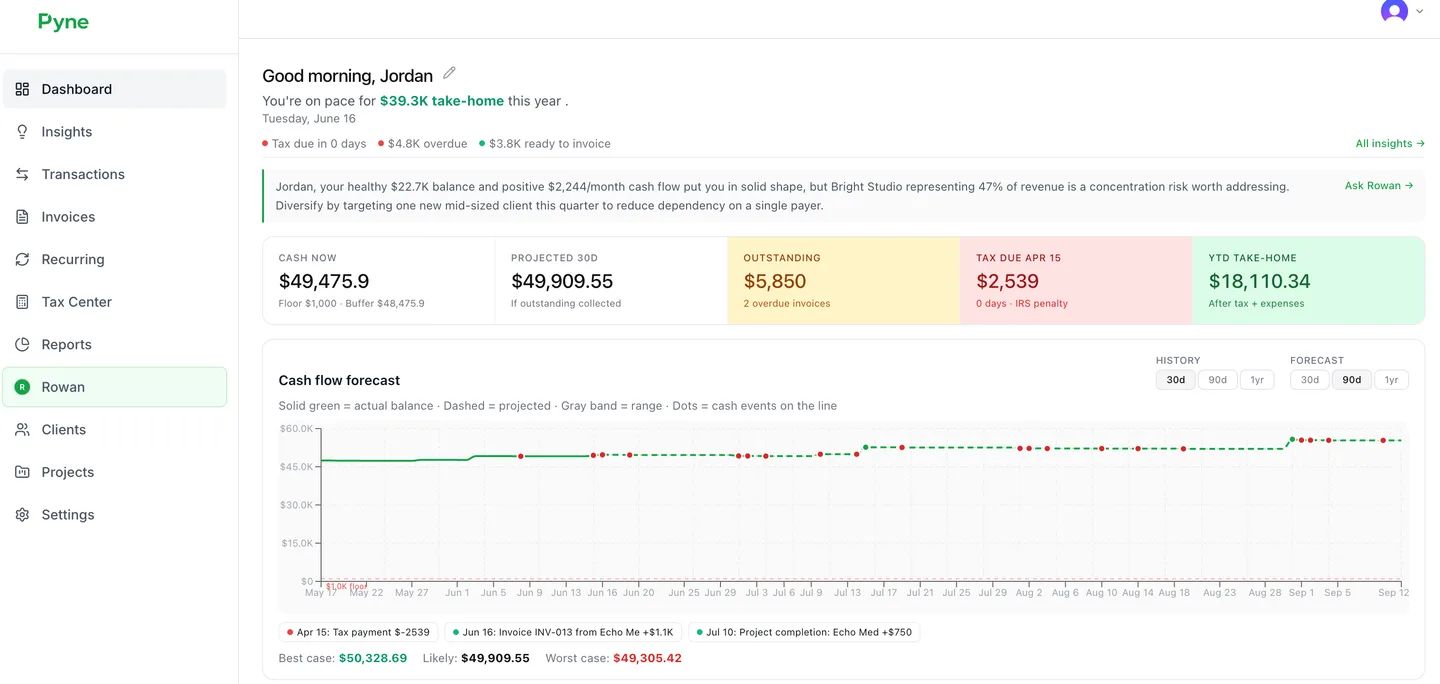
Pyne connects to your business accounts, tracks client deposits as they land, and builds a rolling 90-day cash flow forecast from your real numbers and open invoices. It also estimates your quarterly taxes so your set-aside is based on actual profit. You can ask Rowan, Pyne's AI financial copilot, "Can I keep paying myself $3,900 through February?" and get an answer from your forecast instead of a guess. Pyne does not move money between accounts or run payroll for you, so the transfers are still yours to make. See Pyne pricing to compare plans.
FAQ
How much should I pay myself as a freelancer?
Start with your last 12 months of client deposits, subtract business expenses and your tax set-aside, and divide by 12. Pay yourself about 85% of that monthly figure. Use a lower percentage if your income is falling or you have less than a year of history.
Is an owner's draw taxed?
Not as a separate event. As a sole proprietor, you owe income tax and self-employment tax on your business's net profit for the year, whether you transfer it to yourself or leave it in the business account. The transfer itself does not add to or reduce your tax.
Should I pay myself weekly, twice a month, or monthly?
Match your personal bills. Twice a month, on the 1st and 15th, works well for most people because it lines up with rent and spreads the draw. The frequency matters less than keeping the amount and the dates fixed.
What if I cannot afford a salary yet?
Pay yourself a small fixed amount anyway and grow it as the buffer builds. A low, steady paycheck is easier to plan around than a bigger, random one, and it starts the habit of keeping business money in the business account.
Do I need a separate business bank account to do this?
It is much easier with one. If all your deposits and personal spending share an account, there is no buffer to see and no paycheck to schedule. A separate business checking account and tax reserve make the system visible.
Sources
Related
Pyne provides estimates and general financial insights for informational purposes only. This is not tax, legal, or financial advice.