Safe Harbor for Estimated Taxes: A Freelancer''s Guide for 2026
Safe Harbor for Estimated Taxes: A Freelancer's Guide for 2026
Key takeaways
- The safe harbor rule protects you from the IRS underpayment penalty, not from the tax itself. You can meet safe harbor and still owe a balance in April.
- For 2026, you are covered if your withholding and on-time estimated payments equal at least the smaller of 90% of your 2026 tax or 100% of your 2025 tax.
- If your 2025 adjusted gross income was over $150,000 ($75,000 if married filing separately), the prior-year test becomes 110%.
- The penalty is figured separately for each quarter. A big January payment does not erase a short payment back in June or September.
- The last 2026 payment is due January 15, 2027. You can skip it if you file your 2026 return by February 1, 2027 and pay the full balance with it.
Freelance income is hard to predict, which makes "pay 90% of this year's tax" a strange instruction. You will not know this year's tax until the year is over. The safe harbor rule solves that by giving you a second target based on a number you already know: last year's tax. This guide explains both tests, walks through three worked examples, and shows what to do in the last weeks of 2026. It is education, not tax advice. Check your own situation with a tax professional.
What is the safe harbor rule for estimated taxes?
The safe harbor rule is the set of thresholds that decide whether the IRS charges you a penalty for paying too little tax during the year. Freelancers do not have an employer withholding tax from each paycheck, so the IRS expects you to pay as you go through quarterly estimated payments. Pay enough by each due date and you are inside the safe harbor. Fall short and the IRS charges a penalty on the shortfall.
Per the 2026 Form 1040-ES, you generally must make estimated payments if you expect to owe at least $1,000 in tax for 2026 after subtracting withholding and refundable credits, and your withholding and credits will come in under the smaller of:
- 90% of the tax shown on your 2026 return, or
- 100% of the tax shown on your 2025 return. Your 2025 return must cover all 12 months.
That "smaller of" wording is the whole trick. You only need to clear the lower bar, and you get to pick which one by how much you pay.
What are the 90%, 100%, and 110% tests?
There are really three numbers, and which ones apply to you depends on last year's income.
The 90% test (current year). Pay at least 90% of your actual 2026 tax through the year. This is the better target when 2026 is shaping up to be a smaller year than 2025. The catch is that you are estimating a number that will not be final until you file.
The 100% test (prior year). Pay at least 100% of the total tax on your 2025 return. This number is fixed and already printed on your Form 1040, so it is the easiest target to plan around. It is the better choice when 2026 income is up.
The 110% test (prior year, higher income). If your 2025 AGI was more than $150,000, or more than $75,000 if your 2026 filing status is married filing separately, the IRS swaps 110% in for 100%. You still get the "smaller of" choice. It is just 90% of this year versus 110% of last year.
Two narrower rules are worth knowing. If at least two-thirds of your gross income for 2025 or 2026 comes from farming or fishing, the 90% becomes 66 2/3%. And if you had no tax liability at all for 2025 (your total tax was zero or you did not have to file), you were a U.S. citizen or resident alien for the full year, and that year covered 12 months, you generally owe no underpayment penalty for 2026. Both rules are spelled out in the Form 2210 instructions.
Does safe harbor mean you don't owe more tax?
No. This is the most common misread of the rule. Safe harbor decides whether you owe a penalty. It does not change how much tax you owe.
If you base your payments on last year's tax and your income grows, you will have a balance due when you file. That balance is not a penalty, and it is not a sign you did something wrong. It is the difference between last year's bill and this year's bill, and it is due by the April filing deadline.
That is why we treat estimated payments and your tax set-aside as two separate numbers. Your payments can follow last year's tax. Your savings should follow this year's income. Our guide on how much to set aside for taxes as a freelancer covers the set-aside side in detail.
How do you calculate your safe harbor amount?
Pull out your 2025 Form 1040 and your best projection of 2026 profit. Then work through these steps.
- Find your 2025 total tax. This is the total tax line on your 2025 return, which includes self-employment tax. It is not your balance due, and it is not your refund.
- Check your 2025 AGI. Over $150,000 ($75,000 married filing separately) means you use 110% of the 2025 tax. Otherwise use 100%.
- Estimate your 2026 total tax and take 90% of it. Include income tax and self-employment tax. If you need a refresher on the second piece, see our breakdown of self-employment tax on freelance income.
- Take the smaller of steps 2 and 3. That is your required annual payment.
- Subtract any withholding (from a W-2 job or a spouse's job if you file jointly) and divide what is left across the four due dates.
Worked example 1: income is up, prior-year test wins
Maya is a single freelance designer. Her 2025 return shows $14,000 in total tax and AGI well under $150,000. Business is up, and she projects $22,000 of total tax for 2026.
| Test | Math | Amount |
|---|---|---|
| 90% of 2026 tax | $22,000 x 90% | $19,800 |
| 100% of 2025 tax | $14,000 x 100% | $14,000 |
| Required annual payment | Smaller of the two | $14,000 |
| Each quarterly payment | $14,000 / 4 | $3,500 |
If Maya pays $3,500 on each of the four due dates, she owes no underpayment penalty. She will still owe about $8,000 ($22,000 minus $14,000) when she files in April 2027. If she has been setting aside for her actual 2026 income, that money is already sitting in her tax account.
Worked example 2: a higher earner in a down year
Jordan had a strong 2025: AGI over $150,000 and $40,000 in total tax. A client left in the spring, and Jordan projects $38,000 of tax for 2026.
- 110% of 2025 tax: $40,000 x 110% = $44,000
- 90% of 2026 tax: $38,000 x 90% = $34,200
- Required annual payment: $34,200, or $8,550 per quarter
Here the current-year test saves Jordan nearly $10,000 in cash during the year. The risk is that the $38,000 projection is wrong. If a late-year contract pushes 2026 tax to $52,000, 90% of that is $46,800, and the smaller number becomes the 110% prior-year figure of $44,000. Payments of $8,550 a quarter would fall short. Higher earners with unpredictable income often pay the 110% amount anyway, because it is a known number that cannot move on them.
When are the 2026 estimated tax due dates?
The 2026 Form 1040-ES lists four payment dates:
| Payment | Due date |
|---|---|
| 1st | April 15, 2026 |
| 2nd | June 15, 2026 |
| 3rd | September 15, 2026 |
| 4th | January 15, 2027 |
You do not have to make the January 15, 2027 payment if you file your 2026 return by February 1, 2027 and pay the entire balance due with it. Most freelancers are better off making the January payment.
The quarters are not equal lengths, which trips up a lot of freelancers. We walked through why in our Q2 2026 estimated tax deadline guide.
What happens if you miss safe harbor?
You owe the underpayment penalty, which works like interest on the amount you were short, for the number of days you were short. The IRS sets the rate each quarter at the federal short-term rate plus 3 percentage points. For October 1 through December 31, 2026, the IRS underpayment rate for individuals is 7% per year, compounded daily.
The detail that matters most: the penalty is figured separately for each installment due date. According to the Form 2210 instructions, you can owe a penalty for an earlier due date even if you paid enough later. A big catch-up payment stops the penalty from growing, but it does not reach back and erase what already accrued.
Worked example 3: what one missed quarter costs
Go back to Maya. Say she skipped her September 15, 2026 payment of $3,500 and doubled up on January 15, 2027. That $3,500 was late for 122 days. At 7% a year:
$3,500 x 7% x 122 / 365 = about $82
If she waited until April 15, 2027 to make it up, that same $3,500 would be late for 212 days, which works out to about $142. These figures assume the rate stays at 7% into 2027. The IRS resets it every quarter, so treat them as estimates.
The penalty grows with the size of the shortfall and the number of quarters you miss. The bigger cost is usually the cash flow shock in April, not the penalty itself.
Can you fix a short year in November or December?
Partly. If you are behind on 2026 payments right now, here is what still helps.
- Pay now instead of waiting for January 15. Each day sooner trims the penalty on the earlier shortfall. You do not have to wait for a due date to send money. The IRS lists payment options on its estimated taxes page.
- Make the January 15, 2027 payment large enough to clear the annual target. That stops any further penalty from accruing on the fourth installment.
- Look at the annualized income installment method. If most of your 2026 income arrived late in the year, the 2026 Form 1040-ES notes that this method may lower or eliminate the required payment for one or more periods. It is figured on Form 2210 Schedule AI. If you use it for one due date, you must use it for all of them.
- Know the waivers. The IRS can waive the penalty if the underpayment came from a casualty, disaster, or other unusual circumstance, or if you retired after age 62 or became disabled during the year or the prior year and the underpayment was due to reasonable cause. Underpayments caused by a federally declared disaster generally do not get a penalty at all. Details are in the Form 2210 instructions, and the IRS summarizes the penalty in Topic 306.
State income taxes often have their own estimated payment rules and safe harbor thresholds. Check your state's tax agency separately.
How should a freelancer plan payments around safe harbor?
A simple system that holds up in a lumpy year:
- Set your quarterly payment from the prior-year test. It is a known number. Put the four dates on your calendar with the amount.
- Set aside from each deposit based on this year's income. The gap between the two is your April balance, and it should already be saved.
- Check mid-year whether 2026 is running below 2025. If it is clearly smaller, the 90% current-year test may free up cash. Higher earners on the 110% test should be more conservative here.
- Forecast the payment dates against your cash. A $3,500 payment due the same week a net 60 client pays late is how people end up short. A 90-day cash flow forecast makes those collisions visible early.
How does Pyne help with estimated taxes?
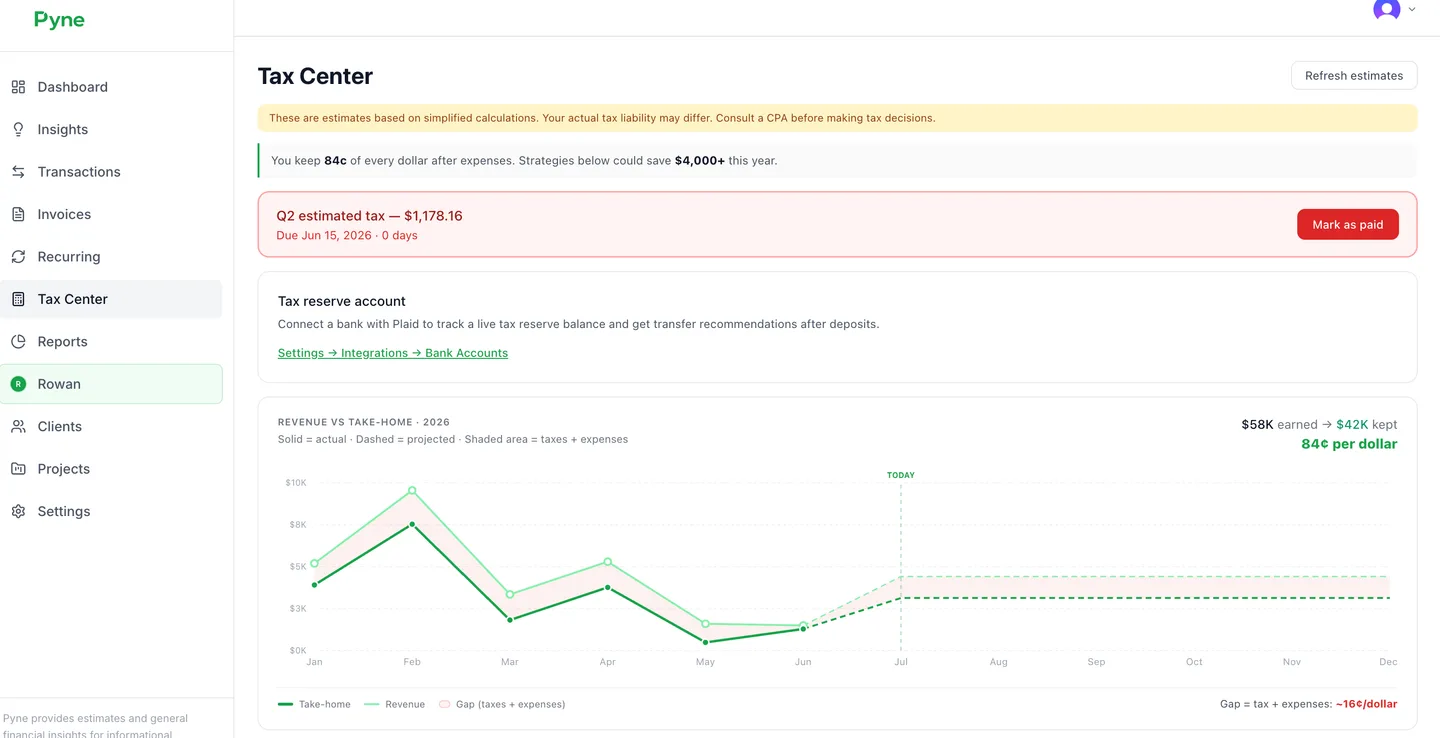
Pyne tracks your client deposits as they land, estimates your quarterly taxes from your actual numbers, and compares your tax reserve account against what you need. In the Tax Center you can ask Rowan, Pyne's AI financial copilot, "Am I safe harbored?" and get an answer from your own data. The prior-year test depends on the total tax from your 2025 return, so keep that number handy. Pyne does not file your return or send payments to the IRS, and it does not replace a CPA for things like an annualized-method calculation or multi-state income. See Pyne pricing to compare plans.
FAQ
What is the safe harbor rule in simple terms?
If your withholding and on-time estimated payments add up to at least the smaller of 90% of this year's tax or 100% of last year's tax, you avoid the underpayment penalty. If last year's AGI was over $150,000 ($75,000 married filing separately), the prior-year number is 110%.
Do I still owe tax in April if I meet safe harbor?
Yes, if your actual tax is higher than what you paid. Safe harbor only removes the penalty. Any remaining balance is due when you file, so keep saving from each deposit based on this year's income.
Is it 100% or 110% of last year's tax?
It depends on your prior-year AGI. For 2026 payments, use 110% if your 2025 AGI was more than $150,000, or more than $75,000 if your 2026 filing status is married filing separately. Otherwise use 100%.
Can I make one big payment in January instead of four?
You can, but you will likely owe a penalty for the earlier quarters. The IRS figures the penalty separately for each due date, so a late catch-up payment does not cancel what already accrued. The exception is if your income genuinely arrived late in the year and the annualized income installment method applies.
What if I had no tax liability last year?
If your 2025 total tax was zero or you did not have to file, you were a U.S. citizen or resident alien for all of 2025, and that year covered a full 12 months, you generally owe no underpayment penalty for 2026. You will still owe whatever 2026 tax is due when you file.
Sources
Related
Pyne provides estimates and general financial insights for informational purposes only. This is not tax, legal, or financial advice.