Freelance Deposits and Retainers: How Much to Ask For
Freelance Deposits and Retainers: How Much to Ask For
Key takeaways
- Most freelance deposits land between 25% and 50% of the project fee. Use 50% for new clients, short projects, and work where you buy anything up front.
- Size the deposit to cover your out-of-pocket costs plus the first phase of your time. On a $9,000 project, that rule points to about 32%, which most people round to a third.
- On one $9,000 project with no deposit, the example below drops to negative $4,000 before the client pays. A 50% deposit keeps the low point at $500.
- A retainer is not a bigger deposit. It is a recurring payment, billed before the month starts, for a defined block of availability.
- Under the cash method, a deposit is generally income when you receive it, not when you finish the work. Set aside tax from it the day it lands.
A freelance deposit is the part of the fee a client pays before you start. It is the single cheapest fix for the gap between doing work and getting paid, and most freelancers still ask for too little of it, or skip it for clients who seem trustworthy. This guide gives you a sizing rule, shows what the deposit does to your bank balance week by week, and explains when a retainer is the better structure.
Why should freelancers ask for a deposit at all?
A deposit moves part of the payment to day zero, so you stop financing the client's project out of your own cash. Without one, you carry every week of labor plus your normal bills until the final invoice clears. With one, the client shares that risk from the start.
It also filters clients. Someone who balks at paying a standard deposit on a signed scope is telling you how the final invoice will go. Our guide to getting paid faster with better payment terms makes the same point: clients who fight hard on deposits often fight hard on collections later.
The third reason is scheduling. When a client books six weeks of your calendar, you turn down other work to hold that space. If they cancel in week two with no deposit, you have lost the work and the alternatives. A deposit is what makes the booking real.
How much deposit should a freelancer ask for?
Ask for 25% to 50% of the project fee. Within that range, the right number depends on three things: what you spend before the client sees anything, how much of your calendar the project blocks, and how much you trust the client to pay at the end.
A simple sizing rule works for most projects:
Deposit = out-of-pocket costs + the fee for the first phase of work.
Out-of-pocket costs are anything you pay before delivery: stock assets, software seats, subcontractors, printing, travel. The first phase is the work you do before the client reviews anything, such as discovery, a first draft, or wireframes. If the client walks after that phase, the deposit has paid for everything you did.
Worked example: sizing a deposit on a $9,000 project
Say you quote $9,000 for an eight-week website project. You will spend $600 on a theme license and a font license in week one. The first phase, discovery and wireframes, takes two of the eight weeks.
- Weekly value of your time on this project: $9,000 / 8 = $1,125
- First phase fee: 2 weeks x $1,125 = $2,250
- Deposit floor: $600 + $2,250 = $2,850
- As a share of the fee: $2,850 / $9,000 = about 32%
So 32% is the minimum that leaves you whole if the client cancels after phase one. Most freelancers round that to a third or go straight to 50% for a new client. Rounding up is fine. Rounding down below the floor means you are lending the client money.
When to ask for 50% or more
Ask for 50% when:
- The client is new and has no payment history with you.
- The project is short, four weeks or less, so there is little time to recover from a no-pay.
- You buy materials, licenses, or subcontracted work up front.
- The project blocks most of your calendar, so a cancellation leaves a hole you cannot fill quickly.
Very short or very small jobs can go to 100% up front. A $750 logo refresh or a one-day workshop does not need staged billing. Charge the whole fee when the client books.
When 25% is enough
A smaller deposit makes sense for repeat clients who have paid on time before, for long projects billed in milestones, and for clients whose procurement process makes large upfront payments slow to approve. In those cases the deposit is mostly a commitment signal, and milestones carry the rest.
What does a deposit do to your cash flow?
It raises your lowest balance during the project, and the low point is the number that decides whether you can pay rent. Here is the same $9,000, eight-week project under three payment structures.
Assumptions: you start with $5,000 in the bank, this is your only active project, and you pay $4,500 in monthly expenses at weeks 4, 8, and 12. The project is delivered at the end of week 8.
| Structure | Payments | Balance at week 4 | Balance at week 8 | Lowest point |
|---|---|---|---|---|
| No deposit, net 30 on delivery | $9,000 at week 12 | $500 | negative $4,000 | negative $4,000 at week 8 |
| 50% deposit, balance net 15 | $4,500 at week 0, $4,500 at week 10 | $5,000 | $500 | $500 |
| 30/40/30 milestones | $2,700 at week 0, $3,600 at week 5, $2,700 at week 10 | $3,200 | $2,300 | $500 at week 12 |
All three end at the same $500 by week 12, because the client pays the same $9,000 either way. The difference is what happens in between. With no deposit you need $4,000 from somewhere in week 8: a credit card, a draw on savings, or a late rent payment. With a deposit, you never go below zero.
This is the same logic behind a 90-day cash flow forecast. Your safe-to-spend number is the projected low point, not today's balance. A deposit is the easiest way to move that low point up.
Should you use a retainer instead of a deposit?
Use a retainer when the work is ongoing rather than a single deliverable. A deposit is a slice of one project fee. A retainer is a recurring payment for a defined amount of your availability each month, billed before the month starts.
Retainers fit work like monthly content, ongoing design support, fractional operations, or maintenance. They do not fit a one-time build with a clear end.
How to price a monthly retainer
Price the retainer from the hours it reserves, then decide what happens when the client goes over or under.
- Hours included: 20 per month
- Retainer fee: $3,000, billed on the 1st for that month
- Effective rate: $3,000 / 20 = $150 per hour
- Overage rate: 125% of the effective rate, so $187.50 per hour, billed in arrears
Three terms keep a retainer healthy:
- Bill in advance. The retainer pays for availability, so it is due before the month, not after.
- Decide on rollover up front. Most freelancers let unused hours expire or roll over for one month only. Unlimited rollover turns your retainer into a debt you owe the client.
- Set a notice period. Thirty days' notice to cancel gives you time to refill the calendar.
If your effective rate on a retainer comes out lower than your project rate, check it against your true freelance hourly rate. Steady income is worth something, but not an unlimited discount.
Retainer vs deposit at a glance
| Deposit | Retainer | |
|---|---|---|
| What it pays for | Part of one project | A month of reserved availability |
| When it is billed | At signing | Before each month starts |
| Typical size | 25% to 50% of the project | Hours reserved x your rate |
| Ends when | The project is delivered | Either side gives notice |
How do you ask for a deposit without losing the client?
Present it as how you work, not as a special request. Put it in the proposal, in the contract, and on the first invoice, in the same plain language each time.
A line that works in a proposal:
"My standard terms are a 50% deposit to reserve your start date, with the balance due 15 days after final delivery. I'll send the deposit invoice when you sign, and work begins when it clears."
Three details make this stick:
- Work starts when the deposit clears. Not when the client says it is on the way. If you start early, the deposit stops being a deposit.
- State whether it is refundable. Most freelancers make the deposit non-refundable once work begins, because it pays for time already blocked and work already done. Write your rule in the contract so there is no argument later. Rules on deposits and cancellations vary by state, so have the contract reviewed if a lot of money is at stake.
- Credit it on the final invoice. Show the full fee, subtract the deposit, and show the balance due. Clients should never have to wonder whether they already paid part of it.
If a client asks for net 60 on top of no deposit, that is two months of financing you would be giving them. Our net 60 payment terms guide covers how to trade a deposit for longer terms on the balance.
When is a deposit taxable income?
For most freelancers, a deposit is income in the year you receive it. That surprises people who think of it as not earned yet.
Most freelancers who file Schedule C use the cash method. Under that method, IRS Publication 334 says to "include in your gross income all items of income you actually or constructively receive during your tax year." Constructive receipt means the money was credited to your account or made available to you without restriction, even if you have not moved it yet. A deposit sitting in your business account counts.
The practical result shows up at year end. A deposit paid in December for work you do in January is generally this year's income, not next year's. If you are on the accrual method, the rules for advance payments are different, and IRS Publication 538 covers them.
Two habits keep deposits from wrecking your tax planning:
- Set aside tax the day the deposit lands. If your set-aside rate is 30%, a $4,500 deposit means $1,350 goes to your tax account and $3,150 is available for the project and your bills. Our guide on how much to set aside for taxes walks through picking that rate.
- Report it whether or not a form shows up. Publication 334 says you must report all business income, "including income not reported to you on a Form 1099." Deposits paid by bank transfer often never appear on one.
This is general education, not tax advice. If you take large deposits near year end or use the accrual method, check the timing with a tax professional.
How do deposits show up in your books and forecast?
Record a deposit as income when it arrives, tag it to the client and project, and put the balance due on your forecast with its expected date. That gives you two numbers that matter: cash in hand now, and cash still coming from this client.
A deposit also changes what you can safely spend. The deposit is real money, but part of it belongs to taxes and part of it is paying for work you have not done yet. Spending the whole thing in week one recreates the same gap the deposit was meant to close.
Keeping deposits in a separate business bank account makes this easier to see. The SBA notes that "looking closely at money-in and money-out helps maintain a sustainable balance between profit and loss," and deposits are where that discipline starts.
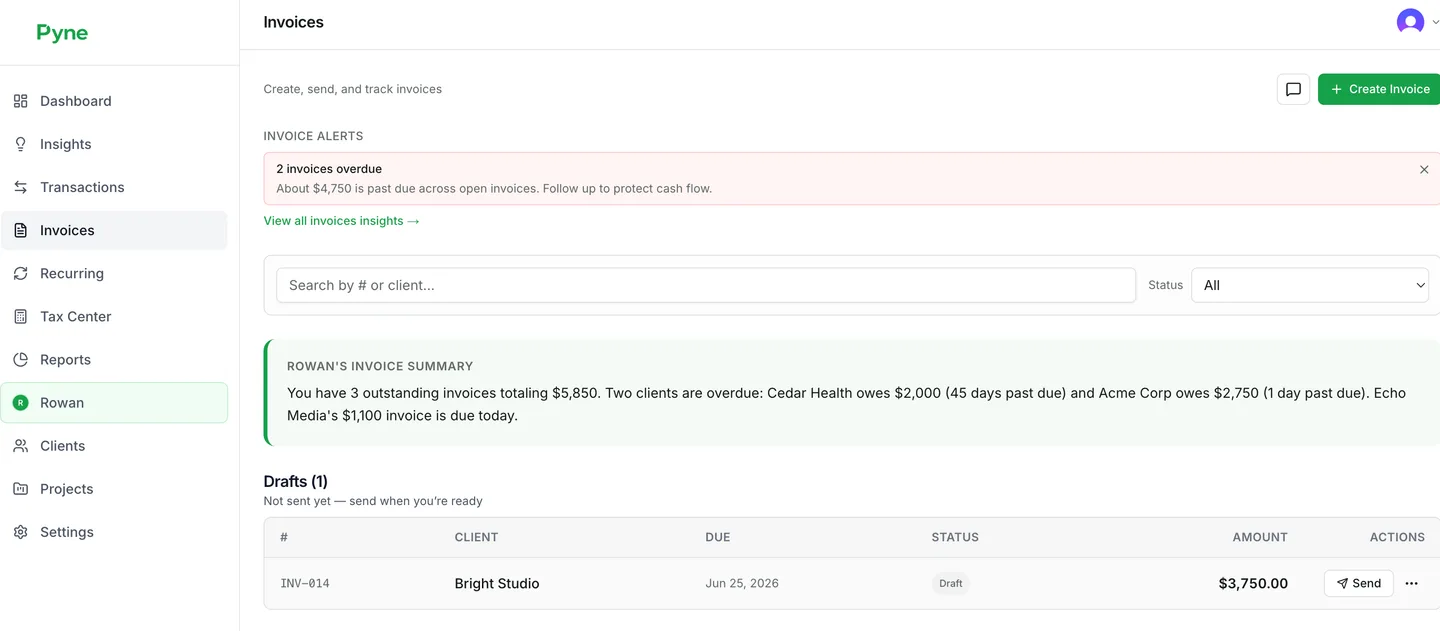
Pyne tracks invoices and deposits against your actual bank transactions, so a deposit shows up as income tied to the project, with the balance due on your cash flow forecast. Rowan, Pyne's AI financial copilot, can answer questions like "if this client pays the balance two weeks late, where does my lowest week land?" Pyne does not write your contracts or decide your deposit policy for you. See Pyne pricing if you want deposits, invoices, and your forecast in one view.
FAQ
What is a typical deposit for freelance work?
Most freelance deposits are 25% to 50% of the project fee. Fifty percent is common for new clients and short projects. Twenty-five to thirty-three percent is common for repeat clients and longer projects billed in milestones. Very small jobs are often paid 100% up front.
Is a freelance deposit refundable?
Only if your contract says so. Many freelancers make the deposit non-refundable once work begins, because it covers booked time and early work. State the rule in writing before the client pays, and check your state's rules if the amount is large.
Is a retainer the same as a deposit?
No. A deposit is part of one project's fee, paid at signing. A retainer is a recurring payment, usually monthly and billed in advance, for a set amount of your availability. Retainers fit ongoing work. Deposits fit projects with a clear end.
Do I pay tax on a deposit before I finish the work?
Under the cash method, which most freelancers use, income generally counts when you receive it. A deposit received this year is usually this year's income even if the work happens next year. Set aside tax from it when it arrives.
What if a client refuses to pay a deposit?
Offer milestone billing instead, such as 30/40/30, so you are never far ahead of what you have been paid. If the client refuses both a deposit and milestones on a new engagement, treat that as information about how the final invoice will go.
Sources
Related
Pyne provides estimates and general financial insights for informational purposes only. This is not tax, legal, or financial advice.